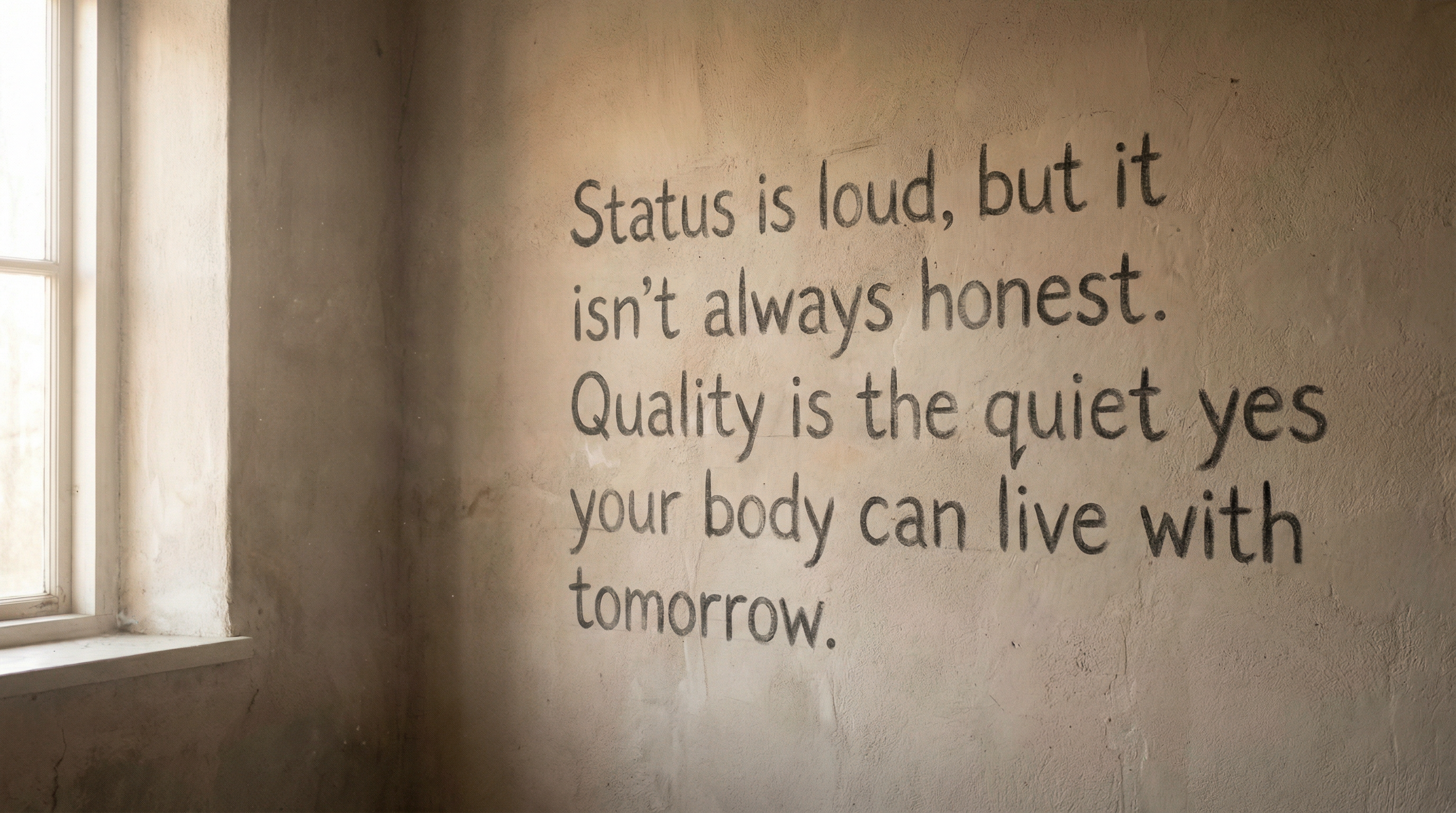
"Status is loud, but it isn’t always honest. Quality is the quiet yes your body can live with tomorrow."
What if some of the things you "want" are really just things you’ve learned to want because they photograph well or sound impressive? Notice the difference between what makes you feel spacious and what makes you feel like you’re performing. Tonight, consider which desire is yours—and which one belongs to the room you imagine watching.
It’s easy to mistake the biggest, shiniest plan for the best plan—especially when the numbers are designed to impress. But when we choose quality over status, we start asking a quieter question: what kind of future will this actually let our bodies live with tomorrow?
This week, the U.S. announced something that sounds like a headline built for awe: a $500 billion AI infrastructure initiative called “Stargate,” backed by major players and framed as a national leap forward. Ten data centers in Texas to start, then more across the country—power, compute, scale. The language is familiar: competitiveness, acceleration, leadership. It’s the kind of announcement that photographs well in the public imagination, all clean lines and big numbers.
What if the real story isn’t just the size of the investment, but the kind of life it’s designed to support? Data centers are physical. They pull electricity, land, water, labor, materials—quiet inputs that don’t always make it into the celebratory caption. Maybe this is where “status” shows up as a national mood: bigger must mean safer, smarter, more prepared. But quality asks different questions: resilient for whom, beneficial for whom, and at what everyday cost?
Consider the two futures hidden inside the same build-out. In one, infrastructure becomes a backbone for better tools—medical research that moves faster, local businesses that can afford smarter systems, public services that don’t collapse under demand. In another, speed becomes the only metric that counts, and the benefits concentrate while the burdens—energy strain, environmental tradeoffs, community disruption—diffuse into places that didn’t get to choose the timeline.
Maybe the invitation today is to practice discernment at a societal scale the way we try to practice it in our own lives. Not “Is this impressive?” but “Is this well-made?” Not “Can we build it fast?” but “Can we live with it well?” What if the most future-ready posture isn’t louder ambition, but a steadier commitment to quality—transparent safeguards, accountable governance, and infrastructure that serves people who will never be in the room where the ribbon gets cut?
A $500 billion AI infrastructure push like “Stargate” is the kind of announcement that can make a country feel powerful—ten data centers, then more, faster compute, bigger numbers. And some of what it could enable is genuinely hopeful: quicker medical breakthroughs, more resilient public services, better tools for everyday work. But these systems won’t live in headlines—they’ll live on land, power grids, water supplies, and in the rhythms of nearby communities. The real question isn’t only “Can we build it?” but “What kind of life will this let our bodies live with tomorrow?” This is where we need each other. Big tech news can turn us into spectators—quietly impressed, quietly uneasy, quietly alone. But quality is a communal practice: listening to the people who bear the costs, naming the tradeoffs out loud, and refusing to treat speed as the only metric. Consider reaching out to someone today—not to debate, but to notice together what feels true beneath the status of the announcement. What if today you practiced “community, not competition” as a small piece of our collective response to the AI age? You might discuss what guardrails would make this kind of build-out feel livable—transparent oversight, local benefits, energy responsibility—and what you’d want decision-makers to hear from ordinary residents. When we process these shifts together, we become harder to divide and easier to protect—one honest conversation at a time.
We looked at how big headlines and louder signals can feel like progress, yet still miss what’s true. Today’s principle—Quality Over Status—invites us to choose the quiet work that holds up tomorrow. So as we step away, let’s trust what feels steady and real.